SOSA – Senckenberg Ocean Species Alliance
Marine Invertebrates
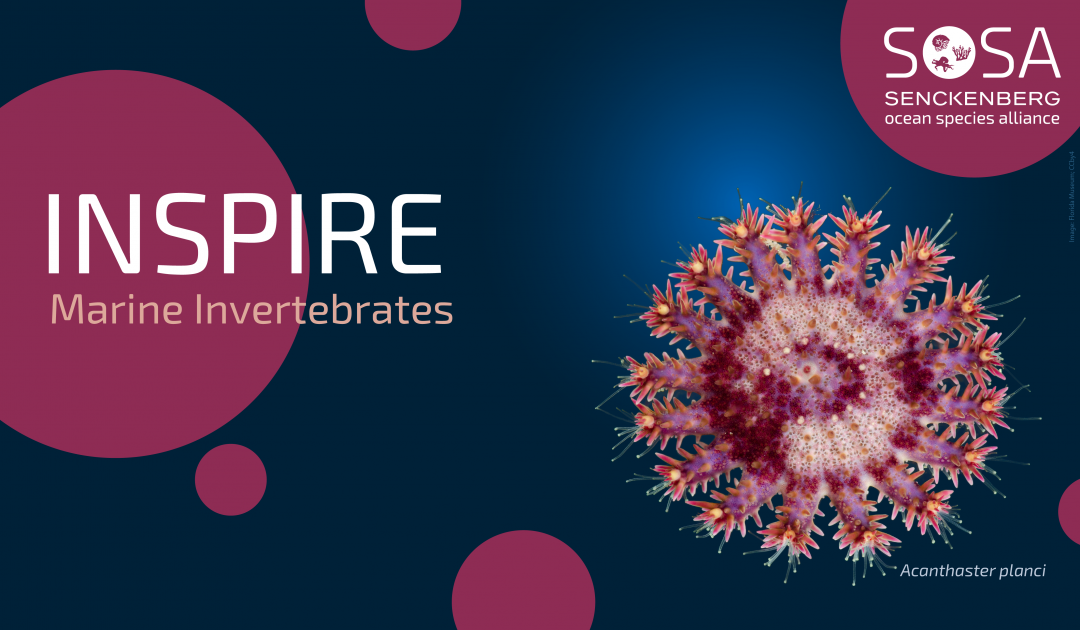
SOSA aims to discover, protect and build fascination for marine invertebrate species. But what are marine invertebrates?
Invertebrates are – simply put – all animals that lack a vertebral column, or backbone, in contrast to the cartilaginous or bony vertebrates. It is an umbrella term for an artificial (non-natural) division of animals – they are unbelievably diverse, comprising over 90 % of all animal species and divided among over 30 different phyla.
Whether on land, freshwater or marine water – invertebrates exist everywhere. We’d like to introduce you to the world of marine invertebrates.
Their size ranges from microscopic planktonic organisms to giant squids, which can grow over 12 m long. Explore these diverse creatures in the gallery below!
The selection above captures only a very small number of marine invertebrates. If you would like to explore more of these incredible creatures, visit Marinvert, our partner site with a growing list of European marine invertebrates.
Evolutionarily, invertebrates represent almost the entire animal kingdom and a simply astonishing range of body plans and adaptations. Comprising all animals except for the small group of the vertebrates, they span across an incredible range from basally derived, sessile and relatively simple groups such as sponges, to highly motile and complex cephalopods (such as squids) and arthropods (like crabs and lobsters).
This tree diagram shows the taxonomic relationships of the eight major phyla of invertebrates. Each branch represents a significant evolutionary event that led to an increase of complexity
Marine Invertebrates: Numerous but Neglected
Animals having a backbone are referred to as vertebrates. They belong to the group of Chordata and include, for example, fish, birds and all mammals. Although this group is the most familiar to us, it represents the smallest proportion in the animal kingdom – In fact, most creatures on this planet are invertebrates – an estimated over 90%.1
The number of described species on land and in water is around 1,162,000; only 50,000 of these are vertebrates2. Although comprising the vast majority of animals, unfortunately, invertebrates do not get the attention they deserve and need. As a result, they are utterly underrepresented on the IUCN Red List (an inventory that showing the risk of extinction of species) and, thus, also receive less conservation action. This is despite many of them being endangered.
The Anthropocene, the current geological epoch characterized by significant human impact on Earth´s ecosystems, brings completely new challenges for the planet. Warming and acidification of the oceans, plastic pollution or deep-sea mining – all of these human-made threats lead to massive species loss that heavily impact marine invertebrates.
Species extinction is not only a great loss for biodiversity, but also matters for humans. Marine invertebrates are an important food source and part of an even bigger food web that humans depend on. They help to regulate the global climate through carbon sequestration and contribute to human health as some are source of important medical compounds.
Explore our gallery to find out how marine invertebrates contribute to our lives.
References
1 Appeltans, W. et al.: The Magnitude of Global Marine Species Diversity. Current Biology 2012, 22, 23. https://doi.org/10.1016/j.cub.2012.09.036
2 Bertrand, S.; Escriva, H. The Evolution of Invertebrate Animals. Genes 2022, 13, 454. https://doi.org/10.3390/genes13030454